

Table of Contents
- Step 1: Get Pre-Approved for a Mortgage
- Step 2: Define Your Budget and Affordability
- Step 3: Explore Affluent Towns in NJ and Commuter Logistics
- Step 4: Partner with a Real Estate Agent
- Step 5: Make an Offer and Navigate the Attorney Review Period in NJ
- Step 6: Schedule a Home Inspection and Manage Contingencies
- Step 7: Prepare for Closing Costs for Buyers in NJ
- Step 8: Complete Title Search and Deed Transfer
- Frequently Asked Questions
Last Updated: October 2, 2026
Step 1: Get Pre-Approved for a Mortgage
Mortgage pre-approval is your first real step toward buying a home in NJ from NYC. A lender reviews your finances and gives you a written commitment for a specific loan amount, signaling to sellers that you’re serious. Pre-approval takes 3-5 business days and requires pay stubs, tax returns, bank statements, employment verification, a credit report pull, and debt-to-income assessment.
A pre-approval letter is NOT a loan offer, it’s conditional. The lender will still order an appraisal and final underwriting once you make an offer, but it shows you’ve cleared the initial financial hurdles.
Start this process 2-3 weeks before you begin house hunting. Pre-approval gives you a clear budget and speeds up your offer when you find the right home.
Step 2: Define Your Budget and Affordability
For NYC residents, the budget calculation is unique: you’re comparing the total tax burden of staying in NYC versus relocating to NJ, not just home prices.
NYC income tax (approximately 3.876% on $150,000 income, or ~$5,814 annually) often exceeds NJ property taxes (averaging 0.84% of home value). On a $400,000 home, NJ property tax runs $3,360-$4,800 annually, making the trade-off favorable for most NYC earners. If you work remotely and no longer owe NYC income tax, your budget increases significantly, confirm your employer’s remote work policy before finalizing your budget.
Calculate Your True Monthly Payment Capacity
Most buyers put down 10-20% of the purchase price. A smaller down payment means higher monthly payments and mortgage insurance; a larger down payment lowers monthly costs.
Calculate your monthly payment using: loan amount (purchase price minus down payment), interest rate (check with your lender), loan term (15 or 30 years), property taxes (NJ averages 0.84% but varies by municipality), homeowner insurance ($800-$1,500 annually), and HOA fees if applicable ($100-$500+ monthly).
Your total monthly payment should not exceed 28% of your gross monthly income (the debt-to-income ratio lenders use). However, after accounting for NYC income tax savings, your true discretionary income may be higher.
Example: A $150,000 earner saves ~$152/month in taxes by relocating ($5,814 NYC income tax vs. $4,000 NJ property tax on a $400,000 home). This savings can be redirected toward your mortgage payment.
Your budget is not just what lenders approve. It’s what you can comfortably afford while maintaining an emergency fund and retirement savings, and for NYC residents, it includes factoring in the income tax savings from relocation.
Step 3: Explore Affluent Towns in NJ and Commuter Logistics
Choosing the right town is as important as finding the right home. For NYC commuters, the decision hinges on commute time and transit access, property tax burden, and school/community quality.
Understanding Your Commute Options
NJ commuting relies on three primary transit corridors: PATH (connects Jersey City, Hoboken, Newark to Manhattan in 20-30 minutes, 24/7 weekend service); NJ Transit Rail (Northeast Corridor Line serves Montclair, Maplewood, Princeton Junction in 30-60 minutes); and NJ Transit Bus (covers areas without rail, 45-90 minutes depending on destination).
Popular Towns for NYC Commuters: Commute Times and Tax Comparison
- Jersey City (PATH access): 25-35 min to Midtown; property tax ~0.65% of home value; median home price $550,000+; excellent schools and waterfront amenities
- Hoboken (PATH access): 20-30 min to Midtown; property tax ~0.68%; median home price $600,000+; walkable downtown, younger demographic
- Montclair (NJ Transit rail + bus): 40-50 min to Penn Station; property tax ~0.95%; median home price $450,000-$550,000; highly rated schools, tree-lined neighborhoods
- Maplewood (NJ Transit rail + bus): 45-55 min to Penn Station; property tax ~0.88%; median home price $400,000-$500,000; diverse community, strong schools
- Princeton Junction (NJ Transit rail): 50-65 min to Penn Station; property tax ~0.72%; median home price $500,000-$650,000; college town character, excellent schools
- Nutley (NJ Transit bus): 50-70 min to Midtown via bus; property tax ~0.92%; median home price $350,000-$450,000; affordable, family-friendly
- Belleville (NJ Transit bus): 55-75 min to Midtown via bus; property tax ~0.85%; median home price $300,000-$400,000; most affordable option, longer commute
- West Milford (NJ Transit bus): 70-90 min to Midtown; property tax ~0.78%; median home price $250,000-$350,000; rural character, outdoor recreation, longest commute
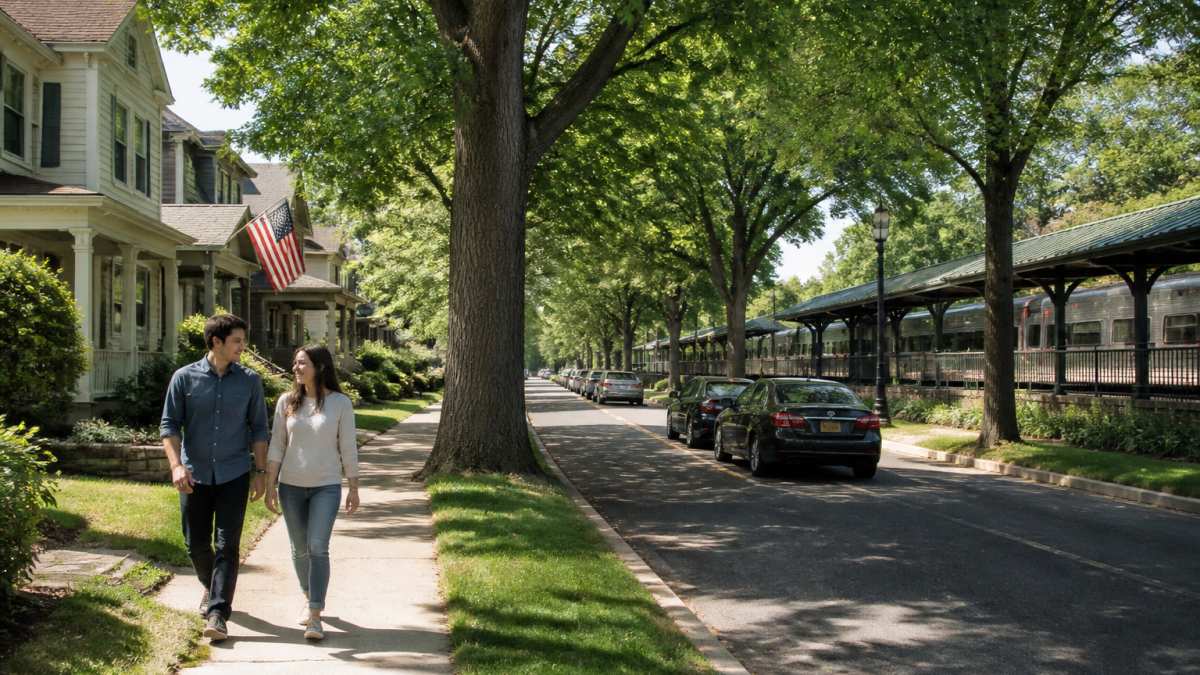
Key Factors When Evaluating Towns: Test commutes during rush hour (45 minutes is typical; over 60 is significant).
Remote Work and Town Selection
Visit your target town multiple times: on a weekday morning (to observe commute patterns), on a weekend (to assess walkability and amenities), and during rush hour (to experience traffic). Drive or take transit to your NYC workplace to confirm the commute feels manageable.
Step 4: Partner with a Real Estate Agent
A real estate agent who knows the local market saves you time and money. They have access to homes before they hit public listing sites. They understand local pricing trends and negotiate on your behalf.
What a good real estate agent does:
- Shows you homes that match your criteria
- Explains local market conditions and pricing
- Helps you make a competitive offer
- Negotiates terms and contingencies
- Coordinates inspections and appraisals
- Guides you through closing
Avoid agents who pressure you to make offers quickly or dismiss your concerns about neighborhoods or commute times. A good agent listens first and sells second.
Step 5: Make an Offer and Navigate the Attorney Review Period in NJ
Making an offer is your formal bid to purchase the home. Your offer includes the purchase price, down payment amount, closing date, and contingencies.
The attorney review period works like this:
- You submit your offer with the purchase price and terms
- The seller accepts or counters your offer
- Once both parties agree, the attorney review period begins
- Each attorney reviews the contract for fairness and legal issues
- Either party can terminate the contract during this period without penalty
- If both attorneys approve, the contract becomes binding
Your offer should include:
- Purchase price
- Down payment percentage
- Closing date (typically 30-45 days out)
- Contingencies (inspection, appraisal, financing)
- Earnest money deposit (usually 1-2% of purchase price)
During attorney review, your attorney will flag any unusual terms or missing protections. This is your safety net. Don’t skip this step or rush it.
Step 6: Schedule a Home Inspection and Manage Contingencies
A home inspection is a thorough examination of the home’s structure, systems, and condition. An inspector checks the roof, foundation, plumbing, electrical, HVAC, and more. The inspection typically takes 2-3 hours and costs $300-500.
Common inspection findings include:
- Roof repairs needed within 5-10 years
- Outdated electrical systems
- Plumbing issues or water damage
- HVAC maintenance or replacement
- Foundation cracks or settling
- Mold or pest damage
Other important contingencies:
- Appraisal contingency: If the home appraises below the purchase price, you can renegotiate or walk
- Financing contingency: If you don’t get approved for your mortgage, you can cancel
- Title contingency: Protects you if the seller doesn’t have clear ownership
Step 7: Prepare for Closing Costs for Buyers in NJ
Closing costs are the fees and expenses you pay at closing. They typically range from 2-5% of the purchase price. For a $400,000 home, expect $8,000-$20,000 in closing costs.
Common closing costs for buyers in NJ include:
- Loan origination fee (0.5-1% of loan amount)
- Appraisal fee ($400-600)
- Title search and insurance ($500-1,500)
- Attorney fees ($500-1,500 in NJ)
- Property taxes (prorated to closing date)
- Homeowner insurance (first year premium)
- HOA transfer fees (if applicable)
- Recording and filing fees ($200-400)
Budget for closing costs separately from your down payment. Many first-time buyers are surprised by these fees. Plan ahead.
Step 8: Complete Title Search and Deed Transfer
A title search confirms the seller actually owns the home and has the right to sell it. The title company searches public records for liens, judgments, or other claims against the property.
Common title issues include:
- Unpaid property taxes or liens
- Easements or right-of-way restrictions
- Boundary disputes
- Deed recording errors
At closing, you’ll sign numerous documents:
- Closing Disclosure (final loan terms)
- Promissory note (your loan obligation)
- Mortgage or deed of trust (lender’s security interest)
- Deed (transfer of ownership)
- Title insurance policy
- Recording documents
Frequently Asked Questions
What is the attorney review period in NJ, and how does it differ from NYC?
New Jersey requires a 3-day attorney review period after an offer is accepted, during which either party’s attorney can review the purchase and sale agreement and propose changes. This is a mandatory cooling-off period unique to NJ. In NYC, there is no standard attorney review period; negotiations happen before the contract is signed. This protection gives NYC relocators time to have legal representation examine the deal before it becomes binding, a significant advantage over NYC’s faster process.
What closing costs for buyers in NJ should I expect?
Closing costs for buyers in NJ typically range from 2% to 5% of the purchase price and include loan origination fees, appraisal, title insurance, attorney fees, property taxes, homeowner insurance, and escrow deposits. NJ also has a transfer tax (typically 0.5% to 1% of the purchase price) and a recording fee. Unlike NYC, NJ buyers often pay a portion of property taxes at closing. Your lender and real estate attorney will provide a detailed closing disclosure 3 days before closing so you know exactly what to expect.
How do property taxes in NJ compare to what I’m paying in NYC?
New Jersey property taxes are among the highest in the nation, averaging 0.8% to 1.2% of home value annually, compared to NYC’s property tax rate of approximately 0.8% to 0.9%. However, NJ offers homestead property tax exemptions and senior citizen exemptions that can reduce your tax burden. Some affluent towns in NJ have higher valuations, which increases tax liability. Research specific town tax rates before buying, as they vary significantly. First-time homebuyer programs in some NJ municipalities may offer tax abatement benefits for a set period.
Do I need a real estate attorney to buy a home in NJ?
Yes, a real estate attorney is required in New Jersey home purchases. NJ law mandates that both buyer and seller have attorney representation during the attorney review period and at closing. Your attorney reviews the purchase and sale agreement, conducts or reviews the title search, prepares closing documents, and represents you at settlement. This is a significant difference from some NYC transactions where attorney involvement is optional. Your real estate agent can refer you to a qualified attorney familiar with NJ transactions.